The Malcolm Election: A Primer

As week two of the 2016 federal election campaign kicked off, there was no more important news than the findings by The Australia Institute (TAI) which clearly show the 2016-17 budget measures will not, in fact, create either growth or jobs.

In short, taxpayer-funded government hand-outs to business and the wealthy do not trickle down to those in greatest need, but are scooped up by – this will shock you – business and the wealthy.

Who are the wealthy?

Australians who enjoy an income of $80,000 or more per year want for absolutely nothing. We can choose between public and private education. Between public and private health care. We do not experience the systemic criminalisation of poverty. Nor the anxiety and transience of housing insecurity. When we turn on a tap, at home or at the park, clean potable water comes out. We can take at least one domestic holiday each year, and save for overseas holidays – the trip of a lifetime, biannual sojourns in the Pacific. Either way, other than our ugly sense of entitlement, we are just fine.

The electorate which reaps the greatest windfall from the jobs n growth budget is Wentworth, the extraordinarily wealthy enclave in the eastern suburbs of Sydney and seat of Prime Minister Malcolm Turnbull.

Meanwhile, the Grattan Institute released findings that the slated company tax cuts would stimulate growth by  0.6% at best and it would take 25 years ‘for the economy to feel the full effect’. In other words: nothing. Margin of error stuff. The ‘growth’ half of the Liberal Party slogan ‘jobs and growth’ is demonstrably false.

In response, the Prime Minister did not engage with the figures. He did not provide a nuanced rebuttal. He did not display his fabled intellect, another lie, so vigorously promoted by his crony commentator mates. He did what weak and lazy conservative thinkers always do: asserted that a demonstrable lie is somehow natural, inevitable, common sense, an infallible truth.

Turnbull said: “It is well understood and well accepted that if you reduce the level of business taxes, company taxes, then you will get a better return on investment, you will see more investment and you will see more employment and that is the inevitable consequence of it.” (The Guardian, Friday 13 May, 2016).

Over at The Australia Institute, economist Richard Deniss found that the government hand-outs to business in the 2016-17 budget will create as many jobs over 30 years as the economy created last month on its own. That is, the economy created more jobs in a month, without a $50 billion hand-out from the saintedAustraliantaxpayer™ than the hand-out to business will create over the (very) long term.

Who is the saintedAustraliantaxpayer™?

Anyone who buys a good or service. It took a Disability Support Pension (DSP) recipient to remind the nation and the foreign-owned Murdoch press of this fundamental fiscal fact. This displeased said Murdoch press, which is neither Australian nor pays tax, but is down for persecuting a sexual assault survivor who is reportedly now on suicide watch.

(In fact we paid $882 million of our tax money to the foreign-owned Murdoch press. This windfall was sent via a morally bankrupt government and a depleted and frankly exhausted Australian Tax Office, which under the profligate and economically illiterate Treasurer Joe Hockey was forced to shed 4,400 jobs in 19 months.)

Disunity and Misleading Claims

As well as the completely unfounded claims (lies) the government broadcasts about its budget, the company tax cut (like the date of the budget itself) saw the Prime Minister and the Treasurer at odds, again, over whether Treasury had done the costings. Did the Prime Minister lie about whether Treasury had done the costings? Why not ask FactCheck, the ABC service to be axed by its brand new ex-Murdoch CEO in the middle of an election campaign?

What does it matter whether the Prime Minister forgot to tell the Treasurer that his re-election strategy relies on a grandiose announcement about a double dissolution over a bill nobody knows or cares about and that this would mean bringing the budget forward because Malcolm?

Who cares whether the Prime Minister lied about Treasury costings and the Treasurer therefore ordered Treasury to release the costings which is clear evidence that the Treasurer hates the Prime Minister and that the government is dysfunctional and in chaos but whatever because Malcolm.

Why not trust a banker, a barrister, a politician in bed with the real estate industry? Malcolm!

In the end we found out that the cost of this pre-election hand-out to Liberal Party donors business would be nearly $50 billion – for basically no return, except a prop on which to hang a slogan. That slogan of course is jobs and growth. The analysis above clearly shows that neither jobs nor growth are an inevitable iron-clad law of economics flowing from budget promises, as the Prime Minister would have us believe. Jobs and growth is nothing but a false and empty slogan of the most Abbottesque variety.

Next came The Australia Institute findings that the company tax cut would represent a massive $10 billion wealth transfer over ten years from Australia to – wait for it – the USA. Not to a developing country. Not to an aid project. Not to investment in renewables or global peace or education for girls (the single most effective way to change the world).

In response, the Finance Minister did not engage with the figures. He did not provide a nuanced rebuttal. He did what weak and lazy conservative thinkers always do: asserted that a demonstrable truth is not true. The Australia Institute findings are ‘factually incorrect. Completely and utterly false’ blathered Cormann, as we stood by for his substantiating evidence. But no, his entire argument amounted to the blare of a quiz show horn. Bzzzzzt. Wrong.

Recall that the Prime Minister relied on not just false but disproven productivity claims for the Australian Building and Construction Commission (ABCC) in his letter advising the Governor-General to dissolve Parliament. The Attorney General QC produced a 13-page letter in support. The Governor General reproduced the false claims in his speech to the amassed MPs who the Australian taxpayer flew back to Canberra at an estimated cost of $20 million to reject a bill we knew would be rejected. (Did the Governor General mislead parliament? My case for the affirmative here).

Such expensive gestures afford huge electoral advantage to the incumbents. Of course, for those smashing economic managers of the Liberal Party, no expenditure of other people’s money to shore up political advantage is too great. Abuse of incumbent power is also no problem.

Meanwhile the Prime Minister, not known for decisive action or sound judgment, dithered and waffled about the budget and a double dissolution, as his fortunes sank in the polls (stand by for fear-mongering on terror and asylum seekers). Meanwhile, his Treasurer hastily scribbled some numbers on the back of a nearby envelope. Young people, Morrison muttered, pencil clamped between his teeth. Health and education no no scrap that. I know. Give business yet another hand-out and troll young people by making another business hand-out look like a constructive policy.

Done.

Democratic process: on policy and law

None of the budget thought bubbles measures have been tabled as bills or passed by both houses of parliament. The government is in no different a position to the opposition: whatever they say is a promise, not a law.

Supply was passed, unamended, the day after the budget was tabled. New policies, which require new appropriations, are still up for grabs. Electoral fodder, nothing more.

At any time, but more so at times like this, it is important to remember that legislation is the codification of policy; and policies are units of ideology. Laws are made by politicians, who belong to political parties, which in turn hold to specific ideologies. The law is not neutral, either in creation or application. There is no magic political-evaporation pond in which to soak our laws when they come into force. Law is inherently political, because politicians make laws.

This is how democracy works. An election is called. Candidates for two major and some minor parties traverse the country, communicating their policy platform to the voters. The policy platform is comprised of planks. In the old days this was a direct metaphor for the stage on which the politician stood, like soap box for public speakers.

One party or coalition secures a majority of seats in the House of Representatives and forms government. Its promises, founded on its ideology, do not suddenly magically turn into law (the great Gough Whitlam came close to performing this magic in 1972, rest his soul). Each policy or promise must be dumped or broken or drafted into a bill and passed by both Houses of Parliament. No new policy, no hand-outs to business, whether tax cuts or the dehumanisation of young unemployed people, are yet law. What is happening in this campaign is a simple abuse of the power of incumbency by the incumbents.

Decoding election messages: the Malcolm campaign

The media has a designated role in the democratic process. This designated role is not to compete between gotcha moments and creepy selfies for the nightly lead. In the English tradition, the tradition forcibly imposed on this continent and her islands, the media is the fourth estate. The first, second and third estates are the Church, the landed gentry (Lords), and the peasants (Commoners).

As an estate, a stakeholder in a democratic system of government, the media have an obligation to report in the public interest. This includes informing the electorate of opposition policies, so the public has a choice on election day. If the electorate are not informed of opposition party policies, we only hear about government, and thus lack informed choice at the ballot box. There are words for one-party states, and none of those words are democracy.

The traditional media method of discharging this duty is to proclaim a commitment to the journalist code of ethics and to balanced reporting. Of course balance is not for vested conservative interests. The Murdoch empire remains a shrieking cabal of nasty privileged sexist racist cronies who broadcast their shameless partisan garbage to the detriment of all but the vested interests of their sadistically selfish boss.

But the supposedly more responsible media are not balanced either. This is partly a function of bullying by conservative governments and big business, via funding cuts (ABC and SBS) or a big bank withdrawing its ad buy (Fairfax).

But it is also a function of the most powerful structural advantage in any democracy: incumbency. The media subscribes to a structural hierarchy of privileged voices. The most powerful voices in society are assumed to be the most important voices.

Never mind that democracy claims to be government by the people for the people; or that the Rule of Law announces that we are all equal before the law; or that the most endorsed document in the history of humanity, the Universal Declaration of Human Rights, says all humans are born free and equal in dignity and rights.

No. Put all that to one side and, like capitalism itself, afford the highest platforms and most prominent positions to the most advantaged. Those from whom we have already heard, whose voices we hear all the damn time; who rarely offer a new insight or creative approach (and never an impartial one); whose social power eclipses all others; and who are largely responsible for the social, geopolitical, and environmental mess in which we find ourselves and in which we have placed our overburdened and burning planet.

Value is scarcity, or so my economics professors told me. Yet here we are with a surplus of vested white men and the occasional woman whose views are largely dull and redundant anyway, but also, according to economic orthodoxy, being in surplus and all, of extremely low worth. It is these voices that the traditional media foregrounds as though they are of the greatest value. We have an over-supply of smug white men. We hear from them endlessly. The bigger problem is how to shut them up. These voices lack substance, honesty, morality, inspiration, creativity, insight… anything, really.

Except incumbent power.

Under this model, every mainstream media campaign report leads with the incumbent. It should be noted that the current incumbents are ministers in a deeply conservative and inept government, sexist and racist and homophobic to a man and woman. These values are thus hyper-visibilised and normalised, irrespective of whether Australians see such ugly positions to accurately represent our values.

Government representatives of the people: a sample

We might hear from AG George Brandis QC, ‘confirming’ that prevention of an imminent terror attack is a fact (when it is not only an unproven claim but sub judice, as the good QC knows, or ought to know).  Brandis is presumably on terror-mongering duty to rehabilitate his dismal reputation as a luddite who failed to notice that numerous letters from Man Haron Monis to his office amounted to overwhelming evidence of Monis’ violent tendencies – which ended in the Sydney siege.

Or we get Scott Morrison saying the Opposition has blown a hole in ‘the budget’ (the Opposition does not control the budget. That would be the job of the Treasurer) and saying ‘this decision, the decision that we have taken today, we had already accounted for’. Okay, Scott. You accounted last month for a decision you made today, but Labor did not. Back in your time machine, mate.

The temporal dissonance is bad enough, but the failure to ever back their own policies with anything other than ‘this is inevitable’ conservatism, or ‘my unprovable claim is a fact’ terror-mongering, or ‘Labor Labor Labor’ from a rabble who have been in government for 2.5 years?

Who else is out and about flinging misleading claims like defecating monkeys?

Why hello Peter ‘plod’ Dutton. Hello you of the recently purchased $2 million+ Palm Beach pad, trolling Tanya Plibersek on her household income. It is an unwritten bipartisan rule of politics to never draw attention to the exorbitant amount we pay politicians for their phony, petty posturing. But household income? Oh, that’s okay. In this instance. You know why? Because Plibersek is a woman.

Ask yourself: have you heard anyone, despite its ostentation, refer to the enormous wealth of Lucy Turnbull nee Hughes? Do you know whether Malcolm or Lucy, and we are talking an extremely high wealth base on any measure here, comes from the wealthier family circumstances? Not a whisper? Yet here is Dutton making veiled references to Plibersek’s husband. Anyone who has followed the fortunes of Mr P knows what else Dutton is implying, a disgusting smear unworthy of further consideration.

And then there is the Prime Minister. The shtrong (pause, deepen pitch, take breath) Prime Minister. A man who told Freemantle workers that massive government contracts are innovative, talented, the future of Australia, twenty-first century.

Let’s take a closer look. The  announcement is a government contract for patrol boats. Are we at war? Is someone invading our remote island?

A: Australian patrol boats are used to turn back desperate people fleeing persecution, many fleeing persecution of our making, in Iraq and Afghanistan and Syria. So the Turnbull vision of innovation for the future of Australia is to further persecute desperate human beings. Nice.

The announcement was for a government contract. Not a start-up, not the invention of refrigeration, or commercial application of wi-fi, or economies of scale on solar cells. It is a government contract to build patrol boats. This, says Turnbull, is Australia at its best. This is our future. Lovely.

Turnbull is talking about a taxpayer-funded order for military hardware in peacetime. The claims he makes for this ordinary procurement decision are so grandiose, so doused in rhetoric, that there must be a greater ideological purpose. What could this statesmanlike purpose be? When on analysis the rhetoric comes up isolationist, socialist, and racist? Can that be right?

Yep. Turns out the only point is the re-election of the Malcolm government, which stands for literally nothing but itself and its donor mates. Nothing new there, then.

Turnbull followed his racist isolationist speechifying with a visit to Darwin, where the Northern Territory government has leased the port to a Chinese government entity for the next 99 years. This is obviously the greatest threat to national sovereignty since the British took by force the sovereignty of over 300 nations in 1770.

Here on soil stolen by the British and handed to the Commonwealth of Australia which leased it to the Chinese, Turnbull waxed lyrical on shtrong border protection. Think about that.

Is he being wilfully ignorant? Stupid? Has he not heard of soft power, despite the cheer squad who laud his ‘intellect’? Or does he just love money and hate brown people seeking asylum? It is very hard to tell.

Just kidding. It is very easy to tell. Despite being demonstrably terrible at his job, Turnbull likes having it; and when a vested, powerful, wealthy white guy likes what he sees, woe betide anyone who stands between him and his object of desire. No isolationalist nationalist xenophobic rhetoric is too low to go.

Six More Weeks: A Survival Guide

Happily, the way to understand media coverage of all this woeful garbage is not difficult. It is not intellectually demanding, or more complex than that, as people out of their depth in public are trained to say.

First, every day is opposite day in the Liberal Party. The reason is that their policies are designed to benefit their own, their base and their donors; but must be sold as if the policy will produce some general social good – in order to win the election. While the Grattan and Australia Institutes have done fantastic work, and our system requires evidence to debunk the myths and lies being flung about, there is no need for the average punter to decode or analyse or crunch numbers. Just ask two simple questions:

  • Is the Minister insisting his claim is true without any substantive evidence? It is false.
  • Does the decision in fact benefit business and the wealthy? Then that is its point.

The dedicated punter can perform further checks. Turn the claim around, and see if its exact opposite seems to resonate, to more closely correspond to the facts in the world.

  • Turnbull is a good economic manager: take a look at the deficit
  • Turnbull can be trusted: Turnbull has reversed his positions on GST, state tax collection, marriage equality, the Republic, climate change (etc)
  • Turnbull is a good leader: Turnbull failed the Republic campaign and failed on climate as Opposition leader. See also NBN. And Godwin Greche (etc)
  • Turnbull is an intellect: Turnbull repeats the same six words at every outing
  • Turnbull is progressive: see marriage equality and climate change, above. See also Safe Schools, cashless welfare, Gonski, university fee deregulation, eating disorder helpline, upfront pathology costs (etc)
  • Turnbull is better than Abbott: Turnbull bangs on about terror and border protection at every opportunity
  • Turnbull is articulate: Turnbull ums and ahhhs like Abbott. Turnbull uses conservative tropes every time he speaks. Turnbull patronises senior journalists to prevail over otherwise much stronger counter-arguments to his claims.

And so on. And on. For six more gruelling weeks.


.


From island prison to island prisons: White Australia and other stories


This week the highest court in Papua New Guinea unanimously ruled that the detention camps established by Australia on Manus Island are unconstitutional, which is to say illegal.

There were two layers to the decision, both of which went against the case for the legality of the camps. The first was that the establishment of the camps was unconstitutional. The second was that the constitutional amendment designed to authorise the establishment of the camps was itself unconstitutional.

The next day the PNG Prime Minister Peter O’Neill announced that the camps would be closed. Bear in mind that the case was brought and won by the leader of the opposition. The PNG Supreme Court may have displayed greater moral fortitude and constitutional rigor than the High Court of Australia, but politics is politics wherever we look.


Two constitutions, four islands: Australia, Papua New Guinea, Manus and Nauru

This post is not about these legal decisions. I leave that to others who are far more qualified than I to write. The PNG decision is available here, and can be contrasted with the case against the constitutionality of Australian detention camps on Nauru here. There are many great explainers of the issues, the legalities and the politics. This article by Madeline Gleeson in The Conversation is excellent, as is this by Richard Ackland in The Guardian. Ackland has been publishing pieces on asylum seeker policy for the layperson for years.

This post is about the failure of the Australian political leadership and society to decolonise our thinking, over 220 years since what Aboriginal pastor Ray Minniecon recently described as the original sin of terra nullius.


The current political landscape and ongoing colonial project

The Australian political landscape this week was once again a garbling of strategy and tactics and messaging and what passes for policy these days. I say ‘what passes for policy’ because current government policy is predictably predicated on doing more-or-less nothing, or nothing differently to immediate predecessor PM Abbott.

As the PNG Supreme Court decision hit the news, the Immigration Minister was accused of contradicting the Defence Minister and the Prime Minister expressed surprise at the PNG court decision while the Immigration Minister said the government had been ‘working behind closed doors’ in preparation for such an outcome. Nothing new here. The month before the Treasurer and Prime Minister were at sixes and sevens on when the budget would be brought down – a matter of some import, or so we would be forgiven for thinking.

We are accustomed to this incoherent and mendacious incompetence from the Coalition government (though we are less accustomed to the Murdoch press completely ignoring it rather than screeching CHAOS!11!! at every opportunity, as was the case during the last Labor government).

There are many contradictions – some would say lies – of the 28 April 2016 prime ministerial interactions with the electorate. Fresh from memorialising victims of a massacre at Port Arthur 20 years ago, Turnbull put on his paternalistic lecturing voice to caution that ‘we can not be misty-eyed’ about indefinite detention on island camps.

These are camps that we know for a fact facilitate mental illness, rape, torture, and murder.

Anyway. Misty-eyed. From the man who did all he could to muster misty-eyed-ness mere hours earlier. It is obligatory at this point to emphasise that I do not intend to disrespect the dead at Port Arthur, which I do not. I write as a mother and human rights scholar, of the value of a single human life.

The events of the day were reliably exploited to:

  • perpetuate the lie that an event in 1996 was the worst massacre in our history, erasing massacres across the country from 1788 to 1928
  • elevate the legacy of John Howard, a racist, small-minded and deeply conservative prime minister who nurtured the meanness and madness of Tony Abbott and who is responsible for conflating asylum seekers with terrorism during the 2001 ‘Tampa affair’
  • reinforce the dominant narratives that ‘our’ dead were lives of value and must be remembered, while those human beings living in ‘offshore’ detention are to be dismissed as means to some other political end

It was like a one-day methodologies workshop on aggressive prosecution of the colonial project, a seemingly endless national preoccupation. Australia Day is merely the most blatant example. Abbott was merely the most blatantly racist recent prime minister. The erasure of the oldest continuing human history on earth continues unabated right here, right now, in Australia, in the 21st century.


The social landscape and dominant cultural hegemony

How might white and other non-Indigenous Australians decolonise our thinking on island exile? For island exile is not new to the white Australian colonial-settler state. It is in our DNA.

I do not mean to hate on this amazing country, cared for as it has been for upwards of 50,000 years by First Nations people. Nor do I ignore the vibrant multiculturalism of 21st century Australian society. I am looking at the dominant cultural hegemony of white middle class Australian values. It is these values that apparently approve the camps on Manus Island and Nauru; which makes these values racist and cruel.

This culture was bequeathed by the colonisers, and continued in recent times by the mean and tricky Howard; the aggressively nasty Abbott; and the cowardly and conformist Turnbull. Conservatives all, these men think that the way things have ‘always’  been done  (always being for as long as a liberal democracy is run by property-owning white men) is the way things ought to be done – despite evidence of a growing discomfort (discomfort!) with the inhumanity our off-shore processing arrangements.


Island exile: nothing new here

Island exile as a social and legal control measure is not only central to white Australian history. It is said that St John was exiled to the Greek island of Patmos in the first century C.E.

From France we have a rich store of lore: Napoleon was famously banished to St Helena, and prisoners including the elusive Papillon (butterfly) to Devil’s Island. Stories of the brutal island prison Alcatraz live on in film; while freedom fighter Nelson Mandela was labelled a terrorist and spent 27 years on Robben Island (and highly accessible island prison lore from the Smithsonian here).

This is not ancient history, any more than that notorious torture site, Guantanamo Bay on the island of Cuba off the coast of the US, is a thing of the past (I strongly recommend the account of David Hicks’ time there by his lawyer Major Michael Mori, pointedly titled In the Company of Cowards).

Placing particular people beyond the laws of the state is a key feature and purpose of island prisons. We are told this is to keep us safe. But the dominant purpose is to prosecute cruel and inhumane treatment of the banished. Cruel and inhumane treatment by the state, but out of sight of the people. Island prisons are not set up to keep us safe from the banished but from knowledge of the cruel and lawless actions authorised by the government we elected.

Even self-exile to the wilderness appears throughout the human story, and it is a universal human trait to makes sense of ourselves and our world through story. Involuntary exile is a harsh measure of social control, and to an island is harsher again. It is therefore imperative on the leadership of the society that has imposed such a measure to tell a credible story about why we have expelled some people from the land itself, to an island.


The past coexists with the present

There is no shortage of examples since 1770 of how island exile has been used to control, up to and including ending, the lives of those who are devalued and dehumanised by Australian society.  This 250-year old cultural hegemony appears unlikely to be dislodged any time soon.

Many of us are familiar with the ‘loaf of bread’ narrative. The invading forces came from a culture which placed greater value on the property rights a baker held in a loaf of bread than on sharing food with the hungry. Steal a loaf of bread, and you’re bound for Kamay (Botany Bay). This denies the poor and the hungry their basic human rights to food, sense of family, belonging and connection to country (as miserable and dirty a country was C18 England, it was still their home, where their family and friends resided).

The ‘remote island’ where we still perpetuate terra nullius thinking like ‘middle of nowhere’ and ‘alien landscape’ was not remote or alien or nowhere to the locals. The ‘hostile country’ was not hostile to its First Peoples. On this incredible archipelago, mother earth to more than 200 distinct Peoples, generations of Aboriginal peoples sustained their law and societies and cultures for upwards of 50,000 years.

These uncontested facts alone prove that the land is abundant and the people live in close harmony with it. But first the English, then the colonials, and now the dominant hegemony are invested in a ‘great man’ approach. This methodology elevates individuals, perpetuating liberal mythology. Shining a spotlight on just a few ‘great men’ illuminates much about the island gulag model that Australia perpetuates today.

For example, Cook came here with the bloated botanist Banks, for whom the Dharawhal place Kamay was renamed Botany Bay. The English filled their barrels with clean fresh water on Palawa shores – without which they could neither sail nor live. It is a matter of historical fact that the English foul their own rivers and streams to the point of undrinkability, and those of others territories, wherever they go.

Palawa lands were later called Van Diemens Land – or The Demon by those Irishmen on whose backs the vicious brutality of English penal practices were inscribed. After a concerted attempt at genocide, the Palawa peoples (‘Tasmanian Aborigines’, in colonial terms) were declared ‘extinct’. What we meant by this social Darwinian erasure was ‘brutally murdered – by us’.

Palawa culture and peoples endure. The claim that there are no more Aboriginal Tasmanians is a lie. Meanwhile, Cape Barren Island was conceptualised by the English as a place for Palawa descendants to die. Think about that. The English claimed to have ‘discovered’ a place where their own ‘great men’ would have perished of thirst without the sustenance of its streams. They declared ‘extinct’ a people whose epic voyages predated the English by 50-70 millennia; peoples who survived the ice age that saw the island formed. The Palawa were there when the island became an island, the invaders framed their attempted genocide as some kind of natural Darwinian phenomenon.

Back on the mainland, in 1788 Phillip set up camp at Warrane (Sydney Cove). He established a punishment site at Mat-te-wan-ye (Fort Jackson/Pinchgut, more rocky outcrop than island but either way surrounded by a large body of water). He sent a boat north to set up a secondary punishment island at Norfolk, an essential part of the colonial project.

Like Tasmanian streams, Norfolk resources were key to colonial survival. Without decreasing the number of mouths to feed at Warrane, by sending them to Norfolk to live off mutton birds, the ‘second fleet’ and its cargo of human misery may have ‘arrived’ to find a pile of white people bones.

Like the first, ‘Second fleet’ reflects the absurdity and arrogance of English naming practices. Australia is an island, populated for 60,000 years. The English claim the first ever fleet of boats to arrive here was in 1788. That we accept this as fact is too absurd for words. There was no other way to get here.

So Phillip used Sydney Harbour and Norfolk islands for punishment and survival. Tasmania was also a site of punishment and exile as the penal bureaucracy was established. Langerrareroune off the coast of Tasmania, named Sarah Island by the colonisers, became a secondary secondary prison – an island off an island off an island. Langherrareroune was chosen for the rocky channel they called Hells Gates, in a fairly typical indicator of what navigating a boat to the island entailed.

Then there are islands where different clans of sovereign peoples were forced together by the colonisers. Like Palm Island off the Queensland coast, a place of great tragedy in a tropical paradise; Rottnest off teh Western Australian coast; and Cape Barren (I wonder what Cape Barren is like?). Aboriginal people were forcibly transported, out of sight, out of mind, as were the convicts before them and asylum seekers today. It didn’t work, and it will never work. It is a terrible mindset, a terrible thing to do, and we proclaim ourselves to be civilised.

Why coerce and isolate people on small islands off the Australian mainland? First peoples, colonial recidivists, refugees?

The answer is fear. Fear of the unknown, because it is not our land to know, fear of our own illegitimacy, fear that we do not really belong here. Fear that somehow in the great karma of things, someone somewhere might do what we did, and take the island by force, and dispossess us of this paradise.

That the contemporary Australian state banishes refugees to remote island prisons is not innovative, it is not civilised, it is predictable and backwards. The origin of these traditions and fears is a remote and windswept island off a (northern hemisphere) continent which experienced wave after wave of violent invasion. It does not originate here, and it does not belong here. On this continent and her islands, an different law, and a different set of cultual values, developed over a much longer period.


Two preventable deaths, one colonial mindset

As I was writing this, news of two preventable deaths came streaming through the news feed. Within minutes of each other. The news was so sad, and so frustrating. I had been reflecting on the colonial mindset that informs Australian treatment of asylum seekers, particularly as colonisers of pacific islands, including Australia as the biggest island in the largest ocean on earth.

From the English imposition of its laws and ways on these lands to the ghastly gulags on Manus Island and Nauru, the idea that it is the laws and culture of a civilised society that produce such outcomes could not be further from the truth.

First there was the devastating news of the loss of Bangarra Dance Theatre musical director. Here is their statement:

The Bangarra clan is unbelievably saddened that our brother David Page is no longer with us. On behalf of Stephen, the Page family and Bangarra, we ask for your privacy and respect at this difficult time.

He was only 55 years old. A towering talent. He achieved huge success with his brother, family and clan. I saw many Bangarra productions, most memorably a performance of Kin at Belvoir St, starring seven young brother cousins, on 26 January ten years ago.  The eulogies will and should be filled with praise. That 55 is the average life expectancy for Aboriginal men might be mentioned.

This sounds young, because it is. My father in law, a proud Aboriginal man, died of cancer at the age of 55. This is the terrible toll of a life expectancy twenty years lower for Aboriginal people than the rest of Australia. This is why the death of David Page also feels close to home. I miss them, for their teaching, for their generosity.

Then came news that the 23 year old man Omid who set himself on fire had died. I cried for Omid too. My oldest son is 23 years old. I raised him myself. We live in a place that demonises some while elevating the health and well-being of others. This includes valuing some children over others. Some babies. Did anyone else find the sight of the Turnbull grandson running around Yarralumla fawned on by all, while refugee babies are locked behind barbed wire, monumentally disgusting?

We should mourn the great David Page who died too young and the life of Omid and other young people who commit suicide in despair including those suffering the intergenerational trauma that causes so much suicide in Aboriginal communities. As we do this we should reflect on our own lives; and on the origins and traditions of governance, law and justice in this country.

Daddy track messaging: More Turnbull strategy from a US television series

There is a scene in the final series of The West Wing where pollster Joey Lucas and Josh Lyneham, heading the campaign for Democratic candidate Matt Santos, explain how daddy-track and mummy-track campaign messaging works to junior staff.

JOEY: All this attention on the leak story, it’s magnifying the inevitable “Mommy Problem”.

RONNA: Mommy Problem?

JOSH: When voters want a national daddy…someone to be tough and strong and defend the country, they vote Republican. When they want a mommy, someone to give them jobs, health care…the policy equivalent of motzah ball soup, they vote Democratic.

As most politically engaged Australians noticed last month, Malcolm Turnbull was trying out yet another slogan when he ‘advised’ the Governor General to recall parliament. His strategy was designed to turn around his flagging popularity and take back the agenda from the Opposition, who had been releasing policy initiatives rather than sloganeering and backflipping. The grand announcement was classic daddy-track messaging and received accordingly by the predictable cheer squad in the mainstream press.

While conformist journalists praised the announcement as bold and Turnbullesque, Turnbull took to the airwaves to sell his paternalistic brand. He hectored and waffled about why the taxpayer should continue to subsidise the fourth and seventh investment properties of wealthy Australians. He spelt out the double dissolution election provisions in our constitution to senior journalists more patronisingly than the way I teach the same provisions to first year law students. It was squirmingly embarrassing and confirmed a long-noted view of Turnbull: he has terrible judgement.

And throughout these appearances, Turnbull kept repeating his new mantra, ‘continuity and change’.

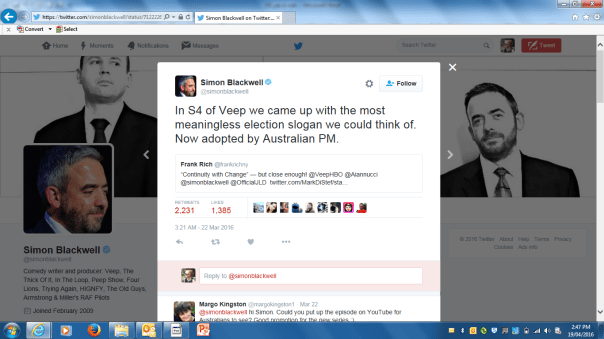
Of course the punters in my corner of the twittersphere were onto it immediately. Another three-word slogan, we scoffed. Listen to Big Mal now hoho he has well and truly caught the three-word disease, said we. Oh so it’s continuity and change now is it. How much more sophisticated than Stop the Boats… wait. No. It is utterly meaningless.

I do not know who first googled the phrase and found it on the side of a fictional campaign bus from a US comedy series. Certainly Mark DiStephano over at Buzzfeed was one of the first to tweet it out. The show itself, VEEP, even bought into the ensuing hilarity and confirmed the slogan was grounded in meaninglessness, which seems apt enough.

VEEP

But all of this is old news and, outside social media, generally poo-pooed by commentators and punters who take themselves oh-so-seriously. You know the ones. They claim Twitter is a hive mind of manufactured outrage and adopt other pompous positions when their perceived seniority is threatened by new media, or millennials, or affordable degrees, or whatever it is that made the scared weird little guys feel scared and weird and little today.

Fast forward to 16 April, and at a completely unnecessary cost of millions, the Australian parliament has been elaborately prorogued with much ushering of black rods and what-not. Pomp and circumstance, sit down as I tell you this, are adored by conservatives. Nothing appeals more to the bunyip aristocracy than the archaic rituals of the colonial-imperial power.

Pomp and circumstance wells the conservative heart. Ushers of black rods and what-not remind them of ‘traditional values’ like shouting ‘neutrality! That’s our thing shut up! Only we can say what is neutral!’ while using and abusing ritual and tradition for cheap and grasping political ends such as desperately trying to stay in power while falling behind in the all-important opinion polls.

The claim that the Governor General is neutral – and that to suggest otherwise is some kind of taboo – suits conservative political ends. It is an exercise in invisibilising and reflects a wider methodology of wielding incumbent power. If the government can convince the commentariat and the electorate that the Governor General is neutral, while busily politicising the office of the Governor General, we may not notice the way incumbent power is being exercised to shore up the incumbent position.

In the same way, Coalition politicians use state power to extend ever-greater control over the citizenry – or specific groups of citizens, such as welfare recipients – while claiming to be the party of ‘small government’. Cashless welfare is not small government, nor are control orders or data retention, or billions spent to torture asylum seekers. This is big-taxing, big-spending, huge-control-over-human-lives government. Yet they persist with the lies of liberalism, because that is the preferred method of neoliberalism. It is all around us, yet invisible, like air – and like air, neoliberal politicians would have us believe that their power is inevitable and natural. It is not.

So has bold daddy Mal called on the Governor General to issue the writs for his double dissolution election on 2 July 2016 yet? No. The Australian parliament had nothing to do once it was recalled at massive expense and the Senate rejected the ABCC bill as per a simple phone call or news feed could have told anyone.

So in a predictably fractious and dreary, repetitive question time, Turnbull then told the Australian parliament that he will wait until after the budget.

‘I will advise the Governor General’, the Prime Minister shouted across the chamber, ‘the Governor General will consider that request, that advice, and he will make a decision.’

This, the Prime Minister lectured us patronisingly, is in accordance with convention.

Ah yes, convention. Like ushers of black rods and the neutrality of the Governor General, it is “convention” to pretend that the Governor General ‘considers’ the advice of the Prime Minister and then makes a decision. Simultaneously, it is “convention” that the Governor General do as the Prime Minister advises. This is clearly a win-win for both parties. Any action, even if it is the complete opposite of a previous or future action, can be justified by convention. No wonder convention is a thing beloved, if regularly flouted, by conservatives.

But the issue for the people is whether the electoral process, the constitution and conventions, the Governor General and the law, are being used for political ends by the Prime Minister in a bid to retain government.

The problem is this. The recall of parliament was done in the proper fashion, by letter from the Prime Minister to the Governor General, which Turnbull assured Cosgrove was legally backed by his Attorney General. You know the one – a QC who can not open the second tab on spreadsheets.

In the small print was a claim that the ABCC bill was so important as to warrant the recall of parliament because the government ‘believes’ that among other things the ABCC will boost productivity.

Obviously the government can believe any old thing it likes – and does, such as the meritocracy mythology that cloaks its every attack on the poor. However, this claim not only has no factual basis, it has been comprehensively disproved by economics professors at Griffith University.

The belief in a positive relationship between the ABCC and productivity began life as an error in an Econotech consultant report commissioned by a former Coalition Prime Minister who also had a notoriously loose relationship with the truth.

The falsity of the productivity and other claims, made by the Prime Minister for the ABCC to the Governor General, have been tracked by Crikey here and The Guardian here and New Matilda here. Among others. There is no doubt whatsoever that the government’s “belief” is a false belief. Not just lacking evidence but founded in – ahem – error (that’s the polite term). A known falsity that has been comprehensively disproved, a mistake that has been corrected by experts. Whatever, the claim is demonstrably false. Turnbull is lying.

There are those who would dismiss the fact that Turnbull is lying as mere politics, say hey, all politicians are liars. Sure. Both these responses are a reasonable reading of the situation.

But here is the problem. The Governor General cited the Prime Ministerial reasons for requesting that he recall Parliament in the Parliament, during the pomp and circumstance of proroguing the Parliament. His speech included the false claims regarding productivity, claims that the Productivity Commission has ‘distanced itself from’ in ‘unusually strong terms’.

The conservative position on this highly questionable speech by the GG is to shout convention! The speech contradicts any suggestion that the GG is above politics and the conservative response is to shout shut up! Neutrality! Only we can pronounce on what is neutral! It is the GG, and thus it must be neutral! That is how the GG or neutrality or convention or whatever suits us works!

Whether it is in the grand tradition of liberal democracy to politicise supposedly neutral offices, or for the head of state to mislead the parliament, is obviously up for debate. I would tend towards a yes stance here. We are talking about a system of government that simultaneously produced the doctrine of separation of powers while making the highest court in the empire a subset of an unelected upper house comprised of landed gentry. This is neither liberal nor democratic and it certainly indicates that nothing is above politics or immune from the power of incumbency.

Either way, the facts remain. The Prime Minister has relied on disproven claims for a belief he says the government holds. He has politicised the office of the Governor General. He has upheld the longstanding tradition of deploying the power of incumbency for personal political ambition. He has shouted convention! Tradition! Neutrality! Shut up! To anyone who points out these blatantly obvious facts.

The next day, Turnbull was citing his ‘strong expectation’ there will be a double dissolution election on 2 July 2016, and maybe there will be. But what’s that Skip? Strong, you say? Is he a big strong man in contrast to that wishy washy opposition? Like a big daddy sort of thing?

The next day, the concerns of the commentariat became the ‘risks’ for the Prime Minister and his strategy – risks that Turnbull imposed on himself. Recall this grandiose double dissolution announcement – once he had secured Senate voting reforms favourable to his party – was hailed as a bold constitutional manoeuvre, nay, Turnbullesque.

Here is what that adjective means: to say or do anything for power, no matter how narcissistic or false, no matter what abuse of incumbency and voting reforms and politicisation of a supposedly neutral institution. And above all else: to desperately project a public image of competent masculinity, while in the backrooms an unruly family of spoilt brats squabble among themselves.

Mommy problem


Neoliberalism is toxic

Much has been written about the rise of neoliberalism and the ‘recent’ decline of standards in political debate. I am on the fence with this one. Was politics really so much gentler and kinder at some unspecified time?

What evidence is there that political leaders have not always been giant bullies who demand obedience from their own while mercilessly cutting down their opponents? Who play politics with the lives of the least advantaged for the purpose of seeking and holding power over those same people and expecting us to what? Trust them? Believe in them? Like them? Vote for them?

The dreary conformist respectability politics 101 narratives go like this: Tim Minchin had a point about accountability for priests who rape children, but he was doing it wrong. He used mean words. But it is okay for Malcolm Knox to use racist patois to rescue a white woman from the scary black man Chris Gayle I know this because Peter Fitz said so.

‘Expert’ commentators note that the Greens, a political party, are playing politics with Senate voting. White men paid from the public purse endlessly gossip about political leaders and staffers while pretending to discuss matters of state rather than, well, gossiping. It is not at all sexist to deploy psychobabble to note that Peta Credlin was a paid staffer rather than elected official.

George Christensen and Cory Bernardi are controversial. It is imperative that progressive thinkers invest our energy in defending a misguided nasty white man like Tim Wilson because gay.

What are we thinking, us tree-hugger hairy-armpit femmos, that we do not take up the cry as directed by the mainstream and immediately re-direct our time and resources to the urgent task of defending Tim Wilson and Peta Credlin and their self-interested greed and quests for power?  How will they muddle along without us?

Meanwhile…

Unfortunately there is just not enough evidence to convict a single police or corrective services officer for causing the death of an Aboriginal person in custody. Ever. Not once. Not even a young Aboriginal woman in police custody with broken ribs who had committed no crime and required urgent medical attention and died on our watch while the state eats lunch.

Sadly our government perpetuating gross human rights violations of people with disabilities and their carers and Aboriginal people and the unemployed and students and young people at massive cost to taxpayers is the price we all pay for cashless welfare to help people on social security to make healthier choices – as the planet burns.

Controversially, heteronormativity and religion are so important in a nominally secular multicultural democracy that kids discovering their own sexuality and gender identity should be immediately and loudly stigmatised and the government should waste millions providing succour to bullies and bigots who hate them.

THESE ARE LIFE AND DEATH ISSUES. CUSTODY KILLS. CASHLESS WELFARE KILLS. BIGOTRY KILLS. ACTUAL HUMAN PEOPLE DIE FROM STATE NEGLECT AND POVERTY AND SUICIDE.

BUT HEY KEEP GOSSIPING AND POSTURING IN THE PUBLIC DOMAIN AND BE HANDSOMELY REMUNERATED BY US TO DO SO. POOR DISABLED BLACK LGBTQI YOUNG LIVES DON’T MATTER AND NOR DOES THE PLANET.

I am not sure what else to say. I could furnish evidence that every single human society in every known place and time – no matter the era, no matter which location on our planet – has created social norms to accommodate gender fluidity and the poor. There is no known human culture or society, anywhere, without specific laws to punish those who take the life of a fellow human being.

These are universal, eternal truths. Part of the human condition. Part of ourselves, because what it is to be human across space and time defines us all.

Yet here we are with a bunch of immature white men, religious bigots all, with the power to make laws, redefining reality and the human condition for their own vicious self-interested  ends.

Neoliberalism has no social conscience. It rejects society and, as such, it rejects humanity. Neoliberalism is an abuser. The polity, the citizenry – us – we are its victim hostage partner. Neoliberalism is white heteronormative ablist neurotypical cis patriarchy on steroids, the worst of the worst.

I despair. And because of how much power neoliberal men wield, I despair for us all.

Religion rhymes with prison

The Tim Minchin song Come Home Cardinal Pell arrived like an avalanche in my news feed this week. This is not surprising. I’m a Minchin fan and atheist; and am friends with people who see no reason to believe in the existence of things for which there is no evidence and have cool taste in music.

The mainstream media caught up the next day. Kristina Kenneally penned a highly lauded piece published in The Guardian which also questioned the place of god in a world where the Catholic Church continues to protect rapists and the protectors of rapists.

The pope was also in the news this week, for snapping at one of the faithful. In Mexico. That was the day after the Minchin song hit the headlines. No coverage I saw linked Francis’ loss of composure to the possibility that providing sanctuary to a man nicknamed Pell Pot would create considerable cognitive dissonance for a man who is assumed to have a moral compass.

Being trained in law and not in psychology, my comment is that it seems highly unlikely that these sets of circumstances – Pell being publicly requested to face the music, the Vatican choosing to safeguard Pell from a Royal Commission, il papa losing his cool – are unrelated.

Much of the commentary on the Minchin song is collected and criticised in this excellent post. The discussion I heard on ABC radio, between four journalists – Richard Glover, Jennifer Hewiit,  Joe Hildebrand and Emma Alberici (in order on which they spoke about the song) – was unanimously critical of the – wait for it – language that Minchin used.

The four were ‘in furious agreement’ (Alberici) in their offence at Minchin and defence of Pell and his apparent rights. These rights remained unspecified, for the obvious reason that every courtesy has been extended to Pell and none of his rights have been violated.

Here are some of the highlights:

Tar and feather him

Shouting scum scum scum

Celebrities jumping on the bandwagon of the cause de jour

Hurling abuse

Lynch mob mentality

Pitchforks at dawn

Abusive

We all know paedophiles are evil of course…

Yes there were a lot of mistakes made…


This is four highly trained and remunerated journalists commenting on the release of a song – a song which says scum once, not three times – which suggests Pell should front the Royal Commission into Institutional Responses to Child Sexual Assault.

The reason Pell should answer the questions of the Commission is that his institution, the one for which he was the most senior representative in Australia, is a known recruiter, harbourer and protector of paedophiles. Priests who rape children. Men of god who use their purported moral superiority to gain access to children and rape those children. That is the problem. They are the wrong-doers. Not Minchin. Not the Royal Commissioner. The rapist priests. We seem to have lost track of this fact somehow.

The most repulsive illogic here is commentators who draw false equivalences between the gross crimes and cover up by Pell and a man singing a song with the word scum in it. These are not comparable moral questions. The word scum is not even offensive to anyone when used in other contexts. But say it about the pope’s man and suddenly those who hold themselves as king mediator of messages call offence.

In the stampede to defend the very important man, we hear all about his rights when his rights have not been breached in any way shape or form. What are we not talking about while blathering about Pell and his not-breached rights? Yes. The victims and survivors of priests who rape children.

Mainstream media feels under threat from social media and the diversity of voices that are now heard in spaces for which they never had to compete, except among each other. The only way they know how to fight back against this threat to their monopoly on controlling the message is to side with power. So they minimalise and trivialise the horrors exacerbated by Pell.

This erases victims from the story. It also directly contradicts the claim that our society condemns adults who sexually assault children in the harshest possible terms. We say we do, and politicians have ramped the child rape sentence up (to a maximum of 25 years) to make it appear equivalent to murder.

Of course this grandstanding has not been and will not be matched by our political leaders loudly condemning the institutions which have failed victims and survivors at every turn.

We do not condemn all men who rape children in real life. Just some of them. We excuse priests and teachers, and burble about their rights and presumption of innocence. To be held innocent until proved guilty beyond reasonable doubt, by the way, is a principle of the criminal law, not investigatory proceedings like a Royal Commission.

At the same time we mobilise millions of dollars to further oppress and violate the rights of Aboriginal people in remote Northern Territory communities on far less evidence than has been collected by the RCIRCSA. A specific group of men are routinely portrayed as sexual predators and condemned en mass across our media landscape.

Where do they think the blue-eyed babies came from?

Children are still not believed. Lives are still wrecked. Families still shun survivors who speak out. Opinion makers still say things like ‘yes mistakes have been made but…’ The Case for the Pope being indicted at The Hague for Crimes Against Humanity – the hundreds of thousands of victims of rapist priests – has been made by none other than Geoffrey Robertson QC. And all we ask of Pell is to answer the damn question: what did you know?


Not in my name: On racist white knight rubbish

There is nothing, absolutely nothing, to excuse the disgrace that is that faux-patois minstrel-show garbage written by Malcolm Knox and published by Fairfax this weekend. It is a disgrace.

Indigenous people, black people, people of colour (as well as many whites) have been united in making clear since it was published that the piece is typical racism of the most quotidian kind.

The usual suspects, ie other white men with platforms, are out in force defending this colonial master routine. The piece includes words like ‘brethren’ and spelling like ‘mon’. It fetishizes facial features like white teeth of black people. It is black face in verbal form (while I thought this almost immediately, I have since seen the same metaphor multiple times on the news feed and am not claiming original thought on it).

The subject was, once again, cricketer Chris Gayle being sexist live on air. Which he was.

One relevant white man editor suggested that calling racism on Knox was a matter for people of the Caribbean. This, in Australia, where the black man who is the subject of the piece plays and was playing at the time. Where there is a strong and capable Indigenous population who know a thing or million about racism in this country. Indigenous people who are in fact the keepers of culture here.

As a white Australian, I want to draw attention to one specific underlying message of the Knox piece. The article is written on the assumption that a white man is permitted – nay, welcome – to use the technology of racism to mock a black man, presumably to defend a white woman sports journalist.

It is possible that Knox thinks he is defending all women. Yet given the gross racial stereo-typing of the piece, we can be reasonably sure that Knox’s thinking did not extend to Indigenous, black, women of colour. No. He implicitly presumes to be writing in defence of white women.

Women did not ask him to perform some gross colonial master mammy routine. We do not need Knox and his racist rubbish to ride in on a white steed and protect us from a black man. We are perfectly capable of condemning Gayle – and Briggs and Dutton and the entire ugly patriarchy – without buy-in from white men spouting racist ‘parody’ (it failed as parody too).

Remember the massacre perpetrator Dylan Roofe’s confession? I remember like yesterday when Roofe’s famous line emerged: ‘I had to do it. They’re raping our women’. It was when a tweet by Kristin Rawls scrolled up my timeline that the full weight of his message hit home. It said

White women, they keep doing this in our name. We are not delicate flowers. STAMP THEM THE FUCK OUT.

No-one is calling Knox a mass murderer, of course. To interpret the connections I am making in that way would be wilful ignorance at best, and shoot-the-messenger vengeance at worst. All I am saying, as have many others before me, is that white women have a specific role in these circumstances to call out racism where the perpetrator hides behind us.

This is not to say that white man racism is the fault or responsibility of white women. We should all call out all racism anyway. But white women are both beneficiary of and excuse for this tedious reproduction of power structures and stereotypes. This one especially – given that white men will back each other until the end of the world – is ours.

So here are a few of the more pervasive narratives. Boring and over-used as each is, it is because we keep hearing such equivalence and gaslighting that we have to keep countering it.

  1. It was parody

Okay. It was deeply offensive, disrespectful and poorly-executed parody. Its minstrel overtones  drew on the antebellum South in the USA. Invoking white slave owners is invoking one of the most horrendous crimes ever committed on this planet, from a wide field of such crimes against humanity.

2. It was a ‘lesson’ in sexism

Step aside, Malcolm. Women are more than capable of calling out, correcting and educating on sexism. Name it, sure – then move out of the way. While intersectional feminism is not widespread or well-understood – and I still make errors of privilege, often – Knox and his cabal of clubby white high-platform white men are not defending women against sexism. They are trolling women for their own click-bait purposes.

3. It’s a free country

This is always the most dreary excuse imaginable. No, it is not. It is a free country for most white men, and most certainly for white men sports writers and major newspaper editors. White men have far fewer chains – social and legal – than any other demographic. Women, Indigenous people, members of the LGBTQI community, people with disabilities: none of us are nearly so free to exercise our rights as are highly remunerated white men with legacy media platforms.

4. Any offence is for the people of the Caribbean

No, it is not. First, it is Knox who has written an offensive piece. It is Knox, his editors and colleagues and apologists who are the problem. And, as mentioned above, Indigenous Australians are the keepers of culture in this country, whether we white folks have grasped this on our personal journey or not. It is the oldest living culture on earth. Gayle was on Aboriginal land when he spoke, Knox was on Aboriginal land when he wrote, I am on Aboriginal land right now. Stop deflecting.

5. Knox is not a racist/Knox is a fine man/Knox is a well-respected writer

This is the Tony Abbott defence of his Rhodes scholarship patron Dyson Heydon. And the George Brandis defence of Heydon. And the Peter Fitzsimmons defence of Knox. And the same wagon-circling defence by white men for white men everywhere. The defence remains breezily ignorant of the fact that calling a white bloke a good bloke is not a defence in itself. We need more evidence than the word of chaps about chaps these days. The evidence is there in black and white. Writing a racially disrespectful column is not ‘fine’ or worthy of ‘respect’.

Knox wrote a racist column. Knox is a comfortable privileged white man. High regard for his writing and position accrue to his demographic more easily than to any other group in society. I am not saying he is a bad writer, although I am saying that since last night we now know he is a racist writer.

But white women have to work twice as hard to attract the same accolades, and Indigenous men twice as hard again, and Indigenous women face even higher barriers to get anywhere in this world. The likelihood of a well-regarded white man being mediocre at best is very high. The likelihood of a mediocre white man who displays overt racism and is defended for it is also extremely high. Today has brought yet more evidence to support the likelihood of these claims.

One last comment I saw was that 2015 was the year of sexism, and now 2016 is shaping up to be the year of racism. I am not attacking this comment – I welcome white men calling out sexism and racism together. But intersectionalism tells us to turn this comment around: it is always the year of the white man, and on the evidence, 2016 will be the year of the white man again.


Southern Cross Ink: on patriotism and violence

Five years ago I went to my first ever Big Day Out. It was a 40th birthday present from my then-17 year old son. We had recently all acquired nanos, courtesy of the Rudd government stimulus package. The offspring loaded mine with music he thought I might like, based on the unfortunate happenstance of coming of age in the 80s. I fell in love with Muse and MCR. He remarked that I have the musical taste of a 15 year old girl.

Anyway, Muse were headlining and there I was with three teen boys – all with lily white skin – and a backpack filled with lychees and olives and sunscreen and a small lunchbox for ice cube refills. The boys were just shy of their 18th birthdays. I made them put on sunscreen in return for beer.

After that, I went back each year. Last year we went with my daughter. At 15 she was old enough for her first big music festival.

JazBDO EvaBDO

Jaz at the Kasabian set, 2010; EvaClaire on Jaz’s shoulders watching Snoop Dogg, 2014

That first BDO was a culture shock. I saw aggressive racism from white men that was overt and overtly ugly. At the time, racist attacks on Indian students were being reported – and the racist component of those attacks largely denied by our political leadership.

As Kevin Dunn (2010) wryly notes, a majority of Australians agree that racism exists in Australia, while 100% of Australian politicians say that it does not.

Around mid-afternoon, in other words in broad daylight, I was walking behind three shirtless young white men draped in our flag and swearing in broad Australian accents. We were at the food court. The food court is a strip of caterers selling meals from all over the world. Both they and I stopped at the dumpling bar.

The white men started raving at the proprietor to go back to his own country. They pulled at their own eyes and affected fake accents to use a range of abusive racist slurs that I have not heard since the 1970s. Back then the words were used more casually than abusively – which is still racist, but marginally less threatening.

As the other two helped themselves to wantons, one of the men leaned in and scooped up fried rice from the bain marie with his bare, filthy hands, tipped his head back, and poured the rice into his boozy gob.

This gross spectacle, of white men behaving violently while asserting cultural superiority – over a man who had clearly laboured night and day to prepare beautiful delicate food – lasted several long minutes. I moved into the space to be served, and to distract the bigots.

They ended their attack with the c-word. I told the closest man to stop speaking like that. Just in my mum-voice: ‘stop speaking like that’. He looked surprised, apologised, and said he was not talking to me. ‘Not you’, he said, like he was the politest guy any mum could meet. I said I don’t care who you’re talking to and moved to place my order. The men moved on. I paid for my dumplings and followed them around at a distance for a while. There were no police or security nearby. I gave up and went back to the main stage.

It is not unusual to observe white men being obscene while asserting that some other group is inferior to them. We heard it this week with Tony Abbott blathering about the superiority of western culture. I have written long and often about Western civilisation, a force of despicable destruction of people and the planet. We also harm our own, having produced a generation more likely to be diagnosed with obesity, diabetes and depression than any other maladies. This is not success.

Later that afternoon I saw a micro-version of the same event. A shirtless young white guy walked up to a drinks wagon, shoulder-shoved the vendor, and dived his hand into the cart, helping himself to several bottles of iced tea. He chucked some ice in the vendor’s face and walked off.

When I relayed these stories, the response from white Australians was nonchalance and denial.

Where was security? Was a common question. Security? What about human decency? At least, unlike with crimes against women, people did not blame the vendors. Yet responsibility quite obviously lies with the violent men; and this was simply not voiced.

This is the Australia we live in; a place where white men who are violent are rarely called to account, and are invariably given the benefit of the doubt. Responsibility for their violence is shifted sideways onto someone else including onto people who were not there, by people who were not there.

Text analysis

I decided to have a look at the wider culture, a culture that supports and fails to condemn the sorts of actions described here. The data set I chose was comments from web pages about BDO and the flag.

The traditional date for BDO Sydney was, for years, the 26 January long weekend. But in December 2005, several large groups of white men violently attacked people of colour in the southern Sydney beach suburb of Cronulla. In January 2006, BDO was a site of ongoing racist violence, including reports of white men demanding people of colour ‘kiss the flag’. The following year, because of these people, organisers asked festival goers to leave their flags at home.

A simple request, easily honoured. Naturally, therefore, the tabloids went nuts. Politicians rushed out solemn statements on rights and flags. The rights of white Australians were, as ever, prioritised and aggressively promoted by white Australians in positions of power: politics, corporations, mass media. The right to not be harassed and assaulted took second place to this jingoistic pandering.

It is my observation that the proliferation of Southern Cross tattoos can be traced to this time. After all, if your Australian flag is on your skin, you can’t leave it at home, right?

That’ll show those Muslims. Or festival organisers. Or someone. Something.

SCTATTOOBDO Slied_Tele

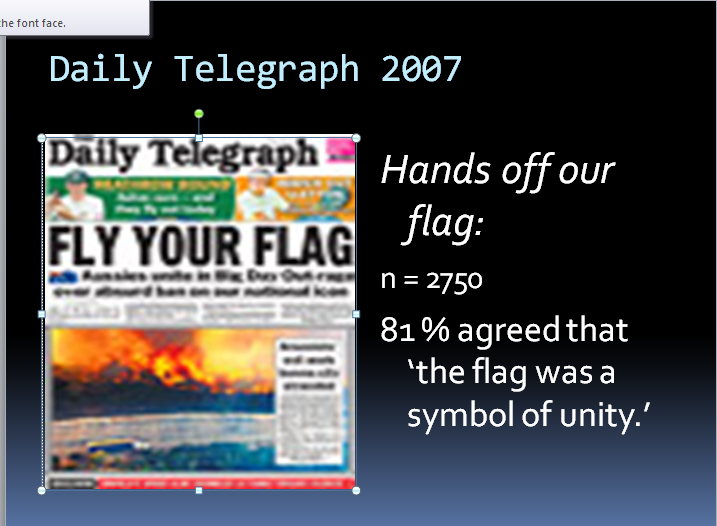
A photo I took with permission ‘for cultural research’ of a festival goer in 2011; the tabloid response to requests to leave the flag at home.

The Daily Telegraph poll hardly bears examination. It is self-selecting, as are the data discussed below; but the Tele poll is also pre-empted by the headline, while the Fairfax data are not.

I used two Fairfax web pages, from Sydney and Melbourne (The Age). The Sydney Morning Herald post asked:

What do you think of the flag controversy? Is the Australian flag a provocative symbol – akin to ‘gang colours’ – as organisers of the Big Day Out suggest? Or is it a unifying symbol? What do you think of the decision to discourage people from taking it to the concert?

This comment thread had 679 entries. Along with 142 comments on The Age post, this represented sufficient bulk to run a text analysis. There was no article, just an open comment thread. I copied the comments into word documents and cleaned up some of the spelling and capitalisation (Aussie and aussi; bdo and BDO) for digital text processing

Central to the digitally-generated semantic map is Cronulla. The suburb name is in the intersection between two theme circles labelled racist and flag. The word riots did not appear – which I suspect it would today. Everyone is referring to yesterday’s anniversary as ten years since the Cronulla riots.

Closer analysis revealed why: the word Cronulla itself had become shorthand for ‘racist riot’, as in ‘we don’t want another Cronulla’ (Sydney) or ‘we don’t want a Cronulla here’ (Melbourne).

lexiBDO

Semantic map of comments at Fairfax in response to ‘the flag question’

A few years earlier a friends’ daughter, who is a young Koori woman, had asked me if Southern Cross tattoos are white supremacist. Her question prompted me to subsequently ask men with Southern Cross tattoos – a tow truck driver, the pizza delivery guy, strangers at BDO – what their tattoo means. Each man replied with some variation of the phrase Aussie pride’.

The link between white supremacy and ‘Aussie pride’ can be seen in the semantic map. The word racism is more closely associated with Australia and Australians than any other concept. Nearby, racist gets its own theme circle. In the same circle is the word patriotism.

The map works on co-occurrence. It is more than a word frequency count. It is a visual representation of which words travel together most closely, to each other, most often. The highest ranking results then become the label on the theme circle. The map is showing that more concepts (the dots) are more closely and frequently associated with BDO, flag, and racist than other words (the theme circles usually reflect the question. If not, the researcher should check whether, or how, the data wandered off topic).

So while the men I asked about their Southern Cross tattoos (which in turn either symbolises or forms part of an Australian flag) said ‘Aussie pride’, the Fairfax readers closely linked the concept of racism to Australian and racist to patriotism – all wrapped around by the dominant theme: flag.

Not all semantic maps mirror life quite so closely: racists claiming patriotism, being dominating, while wrapped in the Australian flag. Again, this is only a representation of what interested Fairfax readers wrote online, but it is not a small sample.

In the view of this self-selecting cohort, the problem with the Australian flag at BDO is racist patriotism.

Predictably,  Prime Minister (Howard), Opposition leader (Rudd), and Premier (Iemma) all weighed in, against the organisers and for the flag. Of course for these political leaders, the issue was not racists flaunting the flag but their freedom to do so. This also reflects what Dunn (2010) has found and what most Australians know: that there is racism in our communities; and that the political leadership deny (obfuscate, minimalize, distract from) its existence.

One reason for political denialism around racism is that politicians facilitate racism.

This comment was typical of reader responses:

Unfortunately, some people fail to see that this is John Howard’s Australia, where racism is allowed, as long as you disguise it as patriotism.

While I agree with this sentiment, I disagree that the situation is some kind of random misfortune. The media coverage, politicians’ statements and informal conversations all pointed to historical, structural, and continuously reproduced racist patriotism with harmful consequences and without negative consequences for the perpetrators.

It may seem a long bow to join these dots from racist patriotism, the Australian flag and Southern Cross tattoos, to a white supremacist outlook, or ideology. More factors must also be present, and shown, such as hate based on race. A key indicator of such hate is violence perpetrated by white people against non-white people, with racist intent, or on the basis of race.  According to the Fairfax commenters, this factor was also present.

There were multiple accounts of the flag-kissing story in the comment thread: ‘I was at BDO last year and idiots wearing flags were making people kiss it and punching them if they didn’t.’ Is this eye-witness verification? The answer depends on to what degree we suspect (or know) that people, with the option of anonymity, make up claims on online forums.

The answer is yes of course some people do, and some forums are more likely to attract rubbish claims. But the claims can also be matched to observations and  experience: of Fairfax forums, of the way white men wearing flags (and others) behave at BDO.

Either way, demanding that a person kiss the flag is trespass to the person and threat to assault. Given the demographics of the parties, it is almost certainly also in breach of s. 18C of the Racial Discrimination Act 1975 (Cth). That’s the section that makes unlawful an act that is ‘reasonably likely, in all the circumstances, to offend, insult, humiliate or intimidate’ a person or group on the basis of race. Punching anyone of any race is assault.

I can’t help wondering how many men were held legally or socially to account for kiss-the-flag humiliation, intimidation or assault. Probably, like the events I witnessed, nobody was held to account in any way. In my view, such inaction – along with the tabloid headlines and tacit consent by the political leadership to obscure violence behind the flag – actually facilitates this specific kind of violence.

Other eyewitnesses observed that ‘love of country’ was used by those ‘idiots wearing flags’ to be violent and to excuse violence. There is a case to be made that patriotism is itself innately violent. Patriotism is certainly mobilised around violent actions, like war. It is toxic masculinity at its worst. From declarations of war to war crimes, from group threats and assaults at BDO to racist violence at Cronulla, these scenes are initiated and enacted by men.

Jingoism, however, was not confined to young men, only the incidents of violence.

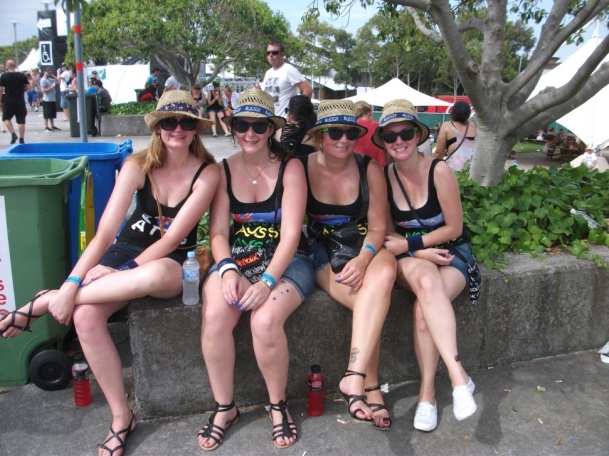
GIRLSBDO olderBDO

Festival-goers dressed in matching ‘heart Aussie’ tees with temporary southern cross tattoos, an older man with permanent Southern cross tattoo – taken with permission.

There is one more theme from the Fairfax comment threads I want to look at, particularly since one of the first reported arrests today was of an older man wearing an Aboriginal flag tee shirt.

Of course which organiser would have the balls to say that no Aboriginal can bring an Aboriginal flag alongside saying no one can bring an Australian flag.

This comes from the ‘special treatment’ handbook of racist ideas. It assumes that authorities are intimidated by Aboriginal people when in fact authorities are extremely racist and violent and oppressive towards Aboriginal people. There is a persistent view that Aboriginal people enjoy special rights – rights that white Australians do not hold. This false conclusion is signalled in this comment. The author implies that Aboriginal people may be able to bring their flag while others can not.

This is racist nonsense on several levels. Firstly, no-one was stopped or “banned” from taking the Australian flag anywhere. People were asked to leave their flags at home, due to racist violence disguised as patriotism. Many chose instead to bring more flags.

More relevantly, Aboriginal people do not wrap themselves in their flag and go on violent drunken rampages, or persecute people of this or that ethnic or religious group. This simply does not happen.

At the time, there would have been fresher memories of the 2004 civil unrest in Redfern. Those events were sparked by the police yet again causing the death of an Aboriginal person and being exonerated by the state.

A community in deep pain, expressing anger at loss and state-sanctioned racist violence, is not comparable to a group of drunken white guys targetting people of colour with threats and assault. There is only one commonality here, and that is white men perpetuating structural violence based on race. This commonality is conflated using  false equivalence, via those casually enabling responses I mentioned above: where white men are being violently racist, we shift their responsibility sideways, whether on to victim-survivors (Aboriginal people, women, children) or onto some vague general non-presence (where was security?).

Even the more informed comments about BDO and flags carried a vague idea of Aboriginal First Peoples somehow denying mainstream – white – rights.

Unless you are Aboriginal, we have all come from somewhere outside Australia. The notion that this should be banned is disgraceful, embarrassing, ignorant, and downright pathetic.

We have seen far more debate and precious little progress since then. Adam Goodes is booed for displaying his culture. Justice for Miss Dhu remains out of reach.  In the Northern Territory police enthusiastically exercise paperless arrest powers while knowing for a fact that it will directly cause more deaths of Aboriginal people in custody.

Violence is no less violent when wrapped in a piece of cloth. The analysis here strongly indicates that racism is exacerbated by overt patriotism, as symbolised by the flag. By the same dynamic, patriotism is used to simultaneously mobilise and excuse violence.

It does not have to be this way. Remember Cathy Freeman, effortlessly embracing her identity? She was criticised for this gesture of reconciliation too. What does it tell us that even Cathy Freeman, holding two flags aloft after winning Olympic gold on home soil, is perceived as threatening to a certain kind of white Australian?

If anyone holds deep knowledge of surviving violence and adapting to multiculturalism, it is Aboriginal Australia.

CathyFreeman


WHEN THE STATE WANTS MORE CONTROL: ON FREEDOM, EQUALITY, DIGNITY, AND RIGHTS

Last week (Saturday 21 November 2015)  I attended one of five rallies against cashless welfare that were held around the country. The rallies were in Modooga, Ceduna, Melbourne, Brisbane and Sydney. All were peaceful. At the Sydney rally, there were excellent speakers and no police.

A group of citizens who are deeply disturbed by human rights violations clearly do not pose the kind of threat to the peace (and opportunities for overtime pay) that came with the racist extremists who rallied the following day.


Ceduna residents rallying against cashless Welfare:

image

This post is an annotated transcript of the speech I gave at the Sydney rally, which can be viewed here. My thanks to Shaymaa Abdullah, who did a beautiful acknowledgement of country on the day, for recording and posting the speeches.

The speech relied on a quantum of prior knowledge on cashless welfare: the policy, its racist origins, and the legislation that recently passed both Houses of Parliament – explanatory memoranda available here.

The cashless welfare bill was passed by the lower house the day that Malcolm Turnbull was sworn in as Prime Minister. This as much as anything tells us that life under Turnbull will be no better than life under Abbott, because the same people (Morrison, Dutton, Bishop) are doing the same things (violating the fundamental human rights of traditional owners, asylum seekers, the poor) with the same ideology.

I started with an acknowledgement of country. I sometimes hear white people rushing through a pro forma Acknowledgement like it is some kind of meaningless chore. It is not difficult to follow basic protocol, such as acknowledging the mayor or local MPs at a community event.

Acknowledgement of country is a simple matter of protocol, etiquette, manners – it does not redress dispossession or genocide, it merely shows respect.

‘I’d like to also start with an acknowledgement of the traditional owners. Of the Gadigal nation. I pay my respects to those who have held and passed on the knowledge, not only for upwards of 40,000 years, but also through centuries of violent dispossession, and attempts by the colonial-settler state to wipe out that knowledge. And I pay my respects to elders past and present.”

I introduced myself and the university where I work and warned the audience ‘I’d like to say a couple of things about the Constitution, which is not immediately riveting, but is very relevant to the state of our democracy today.

Cashless welfare is not new. The Northern Territory Emergency Response Act 2007 (Cth) was passed with a stated purpose, and an actual purpose. The actual reason for the Act was for the re-election of John Howard as the Liberal Prime Minister of Australia. In fact, he lost both his seat and government. So it failed there.

The stated purpose was to address child sexual assault, alcoholism, pornography, in remote Aboriginal communities.

This disgusting slandering of Aboriginal people is also nothing new. It characterises Aboriginal men as sexual predators, which is radically at odds with historical record and contemporary reality, especially for Aboriginal women.

Or as the late Auntie Vera Lovelock said to me, ‘Where do they think the blue-eyed babies came from?’

The Northern Territory is often treated as some kind of giant social experiment. There is a reason for this. As a Territory and not a state, it does not retain the residual powers of the former colonies and now states of Australia. This means that the Territory is effectively under Commonwealth control.

Under s. 51(xxvi) of our Constitution, the Commonwealth has the power to make special laws for the people of any race. Special laws. Which means that it is imperative on any government that wants to operationalise this section to create a moral panic – and insist on the need for a special law for the people of a particular race.

In reality, this power is only ever used to dehumanise and oppress Aboriginal people, the traditional owners and First Nations people of this country.

Can you imagine a Commonwealth government saying we need a special law for the people of the Caucasian race now? That never happens. Can you imagine a government saying we need a special law for the people of the Mongol race, or the Negroid race? Nobody even uses these words any more. Yet here we are with special laws for the people of the Aboriginal race (so-called).

While race is a completely outdated and discredited notion, racism and racists remain among us to this day. We know that the areas where cashless welfare is being rolled out to the ‘mainstream’ have a particularly high proportion of Aboriginal people on social security, on income support, on welfare. Think about those words.

We have a social safety net in this country. We have universal education. Universal health care. We subscribe to the notion that our people should not be starving and dying in the streets. That is the point of social security, and anyone can find themselves on it.

A few months ago Tony Abbott was asked what he stands for. As in all known circumstances, he was incoherent, couldn’t gather his thoughts, didn’t know what he was talking about. But eventually in his incoherent and stumbling way, Abbott said that he believes in small government.

Here’s a quick tip about words:

when a politician says ‘I believe… X’ simply ignore everything that comes after it.

When a politician says ‘I am determined to… X’, don’t bother with that either.

And when a politician says ‘protection’, switch it to control. No-one can ‘protect’ anything unless they have a measure of control over it.

Ask any Aboriginal person what government ‘protection’ means to them, to their family.

Anyway, Tony Abbott reckons he believes in small government and if Malcolm Turnbull was asked if he does too, Turnbull would be compelled to say the same thing.

Cashless welfare is not small government. Data retention is not small government. All the anti-terror legislation passed since 2001 are not small government. This is huge government.

A government that decides what you can put on your shopping list, based on your income, is not small government.

Cashless welfare is also incredibly expensive. There are no efficiency dividends to this policy. There are massive costs involved in rolling out the hard ware and the software – the card, the compatibility systems – in the IT workers and case workers – all paying middle class mortgages with poor peoples’ lives.

This ‘just doing my job’ complicity is, as ever, disgusting.

Cashless welfare is scheduled to start in Ceduna in February if the government can not be stopped and held to account for the gross human rights abuses it embraces. The massive reach of this legislation is over all people with disabilities, all sole parents, all carers, all unemployed people, students, youth and sickness allowance recipients.

Everyone except veterans and old age pensioners in receipt of income support can be attacked under this Act.

The stated purpose of cashless welfare is to improve the health of welfare recipients. There is no evidence, no proof, and no truth to this claim. It is the kind of claim that politicians make on the well-founded assumption that most will not seek further (or any) evidence.

In fact, all the evidence from the Northern territory since 2007 shows poorer nutritional outcomes, lower school attendance rates, more children forcibly removed from their families by the state, more women hospitalised as a result of injuries inflicted by family members.

Nutrition, school attendance, stolen children and hospitalisation for assault are all outcomes which heavily and negatively impact on people’s health and well-being. The policy is dangerous and harmful. It is state-sanctioned and state-sponsored violence.

And again, it is also incredibly expensive. Every single dollar going into the pockets of the IT workers and case managers and card manufacturers could be spent on actual real health services for low income people.

Like dental care, for example. Rich people get to keep all their straight white teeth. Poor people do not. This effects every single aspect of life, from nutrition to job prospects. The primary costs do not even begin to take into account the huge increase in costs to the criminal law system. This is a cost to the states and territories, not the Commonwealth.

Grotesque vote-buying populism from a Commonwealth government that passes the costs on to the states is also nothing new. One of the worst examples of this can also be attributed to John Howard, who orchestrated the so-called baby bonus. This irresponsible and profligate spending sheeted back huge costs: to youth shelters, womens shelters, high schools, community services departments.

This is the real record, the true legacy, of a party that Australians persist in seeing as ‘better economic managers’. They are not. They are terrible economic managers. Absolutely hopeless.

The Liberal Party of Australia as a group are socially privileged, economically illiterate, and cruel. Their privilege and wealth is sustained by the poor; and their political power is sustained by members of the comfortable middle classes who insist, for their own self-interested reasons, on believing the mythology of meritocracy.

This is the actual purpose of every inhumane measure of control over the poor, over people with disabilities, over Aboriginal people, over women: to sustain the lie of merit-based reward in the liberal democracies.

The case against income management is strong, and is over eight years old in the Northern Territory. No case has been made by anyone with the power to stop the expansion of this highly questionable policy – not for the breaches of the Anti-Discrimination Act, the attacks on people with disabilities, the poverty and shame and humiliation and hardship that cashless welfare will inevitably, undoubtedly produce.

All humans are born free and equal in dignity and rights.

image

`


ON DEMOCRACY AND DESTRUCTION OF THE PLANET


Like many, many others, I am feeling deeply ashamed of Australia as a nation. Our political leadership is utterly bankrupt, bereft of any integrity it ever had. But it is not all bad news.

Yes, we pursue breathtakingly cruel policies towards First Nations peoples and asylum seekers and people with disabilities and anyone other than the demographic elites who fund and run the political class. Our record on environmental destruction, from carbon emissions per capita to species extinction to digging up and shipping out the most dangerous substances on earth, is second only to the gross violence and greed of past and present imperial powers.

Here in sunny, safe, wealthy Australia, we actively exacerbate the two greatest disasters of our time. These are the 60 million displaced people in the world – and many more living under violent attack, including by us. At the same time, we continue (or fail to halt) wanton destruction of the planet, up to and including climate crises.

Planet management: Climate crises and War

Humanity caused this, or recognisable groups of humanity caused this, I am a member of one such group – white people. We know we caused it, and yet we refuse to stop causing it, for no other reason than an insatiable greed for comfort and consumables; and for power and control: over people, over territory, over resources, over the earth herself. (Friends – yes, I still have some – have been known to point out that these kind of posts, which I write often, are the death throes of my once small-l liberal heart. They are correct.)

This mess is a man-made mess; and a mess that can be laid squarely at the feet of what is – ridiculously – called western civilisation. Across the globe and across recent centuries, those who have failed so dismally at global leadership continue to loudly lay claim to an inherent capacity to run the planet.

Western civilisation, for all its glorious achievements in the arts and sciences, in fine music and soaring buildings and miraculous technology, is a grinding force of violent destruction, driven on and on in grim and greedy pursuits by political leaders, the wealthy, the military-industrial complex, wars and proxy wars, and any and all of us who conform and comply rather than stand against the tiny, privileged minority.

Much of this is known and accepted, including in the west itself; and as a white woman in a developed nation, I can only speak from the western tradition.

Not all bad news, because people power

I have just returned from field work in the north west of New South Wales, or what is properly called the Gamilaraay and Gomerroi nations. One research site was the Liverpool Plains, where their Harvest Festival was timed to coincide with a protest against five proposed, and enormous, new coal mines, to be operationalised by the monstrous Shenhua Watermark Coal Pty Ltd.

One of the most striking patterns to emerge from speaking with those campaigning against these open cut mines was a massive sense of betrayal: betrayal by government, betrayal of the people.

Traditional owners, and there was a significant contingent of Gamilaraay and Gomerroi people, seemed to expect no more (or no less) than to be betrayed and exploited and lied to and violated and harmed by government – and the rest of us – time and time again. Yet members of the mainstream white communities seemed to be reeling in disbelief that government is not, in fact, governing in their interests.

Definition: Democracy is government by the people for the people

Governments which identify as democratic have never governed in the interests of all the people within their jurisdiction. This much is obvious to many, but not nevessarily to agricultural communities whose farms are now under threat.

The main site of betrayal here is that mining approvals are either granted or not stopped by current Coalition governments in New South Wales and the Commonwealth.

One source of that sense of betrayal, therefore, is that the Coalition includes the National Party, for whom most of this demographic have voted all their adult lives. One very powerful lesson was delivered at Harvest Festival by former-National-turned-independent, Tony Windsor.

On a flat bed trailer stage he shared with Gamilaraay-Gomerroi woman Dolly Talbot, Jane Delaney-John from Red Chief LALC, Fiona Simson of National Farmers Federation and Greens MP Jeremy Buckingham – flanked by 44-gallon drum vases of stunning local flora – Windsor spoke clearly to the failures of the political class. Windsor urged the crowd to understand that it is the people who must stop these mines, as we can not rely on politicians to do so.

Dolly Jane Jeremy


flora

The way Tony Windsor spoke to people power articulated a deep and wide democratic deficit, a huge gap between what the people are saying and what governments are doing. What politicians are saying is a third force in this system; and an important one, because democratic deficits are nothing new.

The very long list of people disenfranchised by the dominant hegemonic elite, in democracies so-called, goes back centuries. This disenfranchisement extends to colonised First Nations peoples, slaves, women, non-real property owning men, many people with a disability, stateless persons, and all young people below the age of majority.

Of those groups on the list who now have at least the legal right to vote, none were granted this most fundamental democratic right in return for asking nicely. From the English royalists of the seventeenth century to the ruling classes of the twentieth, those who have the vote have always pushed back, hard, against extending this right to those who did not. The method of push-back, both then and now, is state-sanctioned and state-funded armed violence. That is, police and others who are armed and trained by government (taxpayers) are deployed to violently suppress citizens in a democracy. In the case of  universal suffrage, this is violent resistance by the state to the most basic of power-sharing arrangements: voting rights, in a democracy.

It is from this history that we can glean the critical role of what politicians say when examining democratic deficits (as opposed to what the people are saying and what the politicans are doing). And because we are looking at what politicians are saying, it is necessary to include the various media by which politicians’ claims are communicated, the ways in which politicians’ messages are shaped and framed and distributed, and the extent to which politicians are believed and trusted by the electorate. At the heart of liberalism, from its earliest days, is a lie: the mythology of meritocracy. Every liberal instuitution remains dominated by white men to this day. This is exactly how liberalism has always been.

We can see this operating against the people of the Liverpool Plains on Gamilaraay-Gomerroi country. Back at Ridge Station, Breeza – the base camp of the 2015 Harvest Festival and protest against proposed Shenhua Watermark coal mines – Windsor was the highest profile political speaker, though he has of course retired from politics. Jeremy Buckingham is also widely known, at least in environmental-protest communitities. One current federal politician showed up: Jacqui Lambie, an independent senator from Tasmania. The messages from Dolly and Jane and Jeremy and Tony and Jacqui were unequivocal, and as one: these mines must not go ahead.

On dominant hegemony

In contrast, the politicians who in fact hold general and specific powers to stop open cut mines from going ahead on the rich and fertile lands of the Gamilaraay and Gomerroi are speaking a different language. The central figures here are the NSW Premier, Mike Baird, and his planning minister, Rob Stokes. Their federal counterparts are the Prime Minister, Malcolm Turnbull, and his environment minister, Greg Hunt.

Again, this reflects the history, the context, the prototype of democracy, as established by propertied white men, for propertied white men. It is not always obvious that that these four people (Turnbull, Hunt, Baird, and Stokes) all belong to the exact same demographic.  This is for the same reasons – the normalisation and invisibility of white patriarchy – that many of us remain misled and misguided (ie indoctrinated and lied to) on just how undemocratic are the liberal democracies.

Unlike on that flat bed truck in a Breeza farm machinery shed, there are no women among the LNP leadership who could stop these mines. There are no First Nations people, no young people, no-one who rejects neoliberalism or capitalism. Yet the destruction of the planet on which we all depend to survive can not be traced to the cultures and practices of Indigenous peoples, or what mothers do, or how children and young people behave. No.

It is not difficult to identify when decision-making power is concentrated with a tiny minority, a group sufficiently powerful and wealthy and privileged to quarantine themselves from the harms they cause. The historical record tells us that the liberal democracies have traditionally been run by a powerful and unrepresentative minority who act in their own interests, to the detriment of everyone who is not a member of their group.

The foundations of these structures can again be traced to the seventeenth century struggle in England between the monarch and the parliamentarians (white, power-seeking men all). To return to the historic context is important, because ahistorical decontextualisation is a common strategy of the dominant hegemony (this is just a fancy way of saying that history is written by the ‘winners’). During the English civil war, large groups of armed men killed each other, and women and children – who always suffer the most in such conflicts – over whether an extremely powerful individual or an extremely powerful group of individuals should be recognised as having the legitimate (lawful) authority to rule over everyone else. It is this person or these persons who claim to legitimately hold lawful power to make decisions about how others can and should live.

Power relationships today

In contemporary Australian politics, as with other liberal democracies, members of political parties do the same thing. The Lab/Lib/Nat members and their supporters are like the Royalists, or roundheads. Each is ideologically driven, and seeks to hold power, within the existing power structures, over the rest of the polity. These groups are not uninfluenced by the electorate (the ‘people’ part of the polity), but their main channel of influence-advice is via yet more status quo: wealthy, influential pollsters.

Each major poll is linked to a major media outlet, and each major media outlet is linked to a proprietor. It doesn’t matter what individual reporters or journalists or opinion writers say – wherever their writing appears in the mainstream media, it is framed by the politics of the proprietor, his networks, the chief editor or other executive, his networks, and so on down the hierarchy (and for an excellent analysis of what polls are to democracy; which is a bit like what meritocracy is to liberalism, see http://www.newyorker.com/magazine/2015/11/16/politics-and-the-new-machine).

This is not to ignore the amazing work of the many people and new media operating despite the dominant hegemony. It is merely to describe old media and its enduring and daily influence on the electorate.

The point of unpacking this cultural hegemony is in turn to point to various sides of society in terms of democratic surplus and deficit. The one percent, as the highest-ranks of elites are commonly called – our current Prime Minister belongs to this group, with his estimated $200 million wealth and position at the head of the Cabinet table – can afford to opt out of democracy altogether. The influence of a James Packer or Twiggy Forrest is wielded not via the ballot box but through direct channels to the minister’s office. These men do not send their children to public schools. While everyone benefits from public health services such as ambulances and the big teaching hospitals, only the wealthy can afford to opt in to the most luxurious of private hospitals.

It is the operation of these forces – money, power, and control of the narrative that falsely justifies who has how much of each and why (the mythology of meritocracy) – that has brought the world to the brink today. Since at least the 1830s, the environmental destruction that is caused wherever surplus is pursued has been known, recognised and understood by members of the very societies, cultural traditions and communities who are responsible for such destruction.

These societies and cultural traditions are defined by the use of unrestrained armed violence, as exercised by the empires and colonisers of western Europe and England in particular. The purpose of deploying large numbers of armed men beyond the fledgling nation state was to secure access to, and power over, peoples, their territory, and its natural resources.

And the good news is

Which brings us to the slightly less grim chapter in this story, a tale of 21st century Australia. We are a vast island surrounded by many smaller ones, remote from much of the world, and buffered from much of the world’s troubles by huge oceans and, for upwards of 40,000 years, the wealth that stems from once-carefully managed natural abundance.

It is worth noting that while all wealth can ultimately be traced to natural resources, the line is very direct in Australia. From the sheep’s back to the gold rushes to the resources and mineral booms, we white Australians actually teach our children that this huge Australian wealth is luck and the ‘hard work’ of settler-colonials. In fact, of course, Australian wealth is directly traceable to the past and continuing dispossession of Indigenous people. Whether wool or gold or iron ore, Australian wealth comes directly from the land.

The Australian earth, its rivers and plains, have been trashed since 1788, just as the settler-colonials attempted to destroy the people themselves, the people who had taken such care in custodianship of the land for so many millennia.

And here is the heart of the matter. The settler-colonial state has failed. It has failed to destroy that which it set out to destroy (while claiming that any ensuing destruction would be “inevitable”). The settler-colonial state has failed to be a better land and water manager than traditional owners, failed as a natural resources manager, and failed to create a better human society – in terms of equality and justice in the social sphere.

‘If ever there were a system of government of laws and not men, it is that shown in the evidence before me’

– Blackburn J, Milirrpum v Nabalco Pty Ltd, (1971) 17 FLR 141 (the “Gove land rights case”) describing the testimony of Yolgnu traditional owners in an early land rights case.

And here is the beautiful thing. At the risk of sounding starry-eyed, this continent and her islands endure. Step back, take a look at a world map. In the old days, medieval scholars up in Europe thought we anchored the Southern hemisphere, the planet itself. And leaving aside northern/southern constructions, we do. There is no land mass more remote from other continents on earth than what is now called Australia. There is no bigger island, inhabited and inhabitable, anywhere in the known universe.

We humans build alliances, we find common ground. We are dangerous and cause high impacts, yet I think the subtle and stronger influence comes from traditional owners and, axiomatically, from the land itself. Deep down, every Australian knows that this place is magnificent, bountiful and beautiful. Deep down, every non-Aboriginal Australian knows that this truth is inextricable from another truth: the original and deepest connection to the land – no matter what white law or society or history says – belongs to First Peoples, Aboriginal and Torres Strait Islanders, Indigenous nations, language groups, clans.

Traditional owners, farmers and agriculture, activists and supporters

It is the land that unites us. It is the land that brought farmers to sit with traditional owners, and ecologists, and activists. First peoples, Aboriginal and Torres Strait Islanders, have known this land for millennia. The call from Tony Windsor was that this fight – to stop five open cut coal mines – must be led by traditional owners. I agree. Tony Windsor speaks a truth, and I look up to him for that.

At the same time, I’d say that we white people are not too great at this. Our track record is rubbish. White Australians are generally racist, we actively endorse human rights violations, and are hopeless at defending Aboriginal rights (be it property rights or human rights – as the white law divides the land from its people). As Dolly Talbot said at the Gamilaraay Gomerroi yarning circle, you open the door to us now. Do not close the door when this fight has been won.

Black belonging to land can not be negated or nullified or wiped away by any form of white law, no matter which way the white law exerts itself. This is not to underestimate the force with which those who make and exert white laws – the Turnbulls and Hunts, the Bairds and the Stokes – will exercise their governing authority, their ‘lawful power’ over how others may live.

Recall that this is in fact the protoypical model of democracy – forcefully imposing laws that are bad for the majority of the people, and bad for the land, is what politcians do, but not what they say they are doing.

Some of the good news can be attributed to the democratising force of social media. Very few citizens have the luxury and privilege of political participation (this is called apathy, or disengagement, by those who do). Many of us are too busy looking after our own and our families’ survival. But very many citizens have a smart phone and a social media account.

Betrayal of the governed by the government is not new to most. In Breeza, those who are experiencing an awakening turned around and found that there are highly skilled, politically engaged, deeply knowledgeable groups of people already standing up. The farmers have joined the traditional owners, ecologists, environmental activists – to stand against government which does not govern in the interests of the land, and therefore does not govern in the interests of the people.